Launch offer — valid today only

📄 Digital book in PDF · read it on your phone or print it

Illustrated Irrigation License Exam Prep: Hydraulics in 5 Steps, Every Time, and Backflow at a Glance One Topic on Every Page

For the TCEQ Landscape Irrigator, the NC Irrigation Contractor and the CIC exams. Static and dynamic pressure, friction loss charts, zone flow, head-to-head spacing, precipitation rate, the 4 backflow devices, valve wiring and ET scheduling. Every topic gets its own page: the drawing first, then what you need to remember. 64 illustrated pages.

GET THE 64 ILLUSTRATED PAGES

🔒 Secure checkout · PDF by email · 30-day guarantee

Every topic, its own pageEach calculation drawn, with the explanation right beside it
64 illustrated pages8 parts, from the water path to the exam review
Up-to-date sourcesTCEQ 30 TAC Ch. 344, NC G.S. 89G and the IA's CIC exam outline
PDF by emailFormat

Look Inside the Book

Every page has one big drawing and a box with the numbers and rules you need to know:

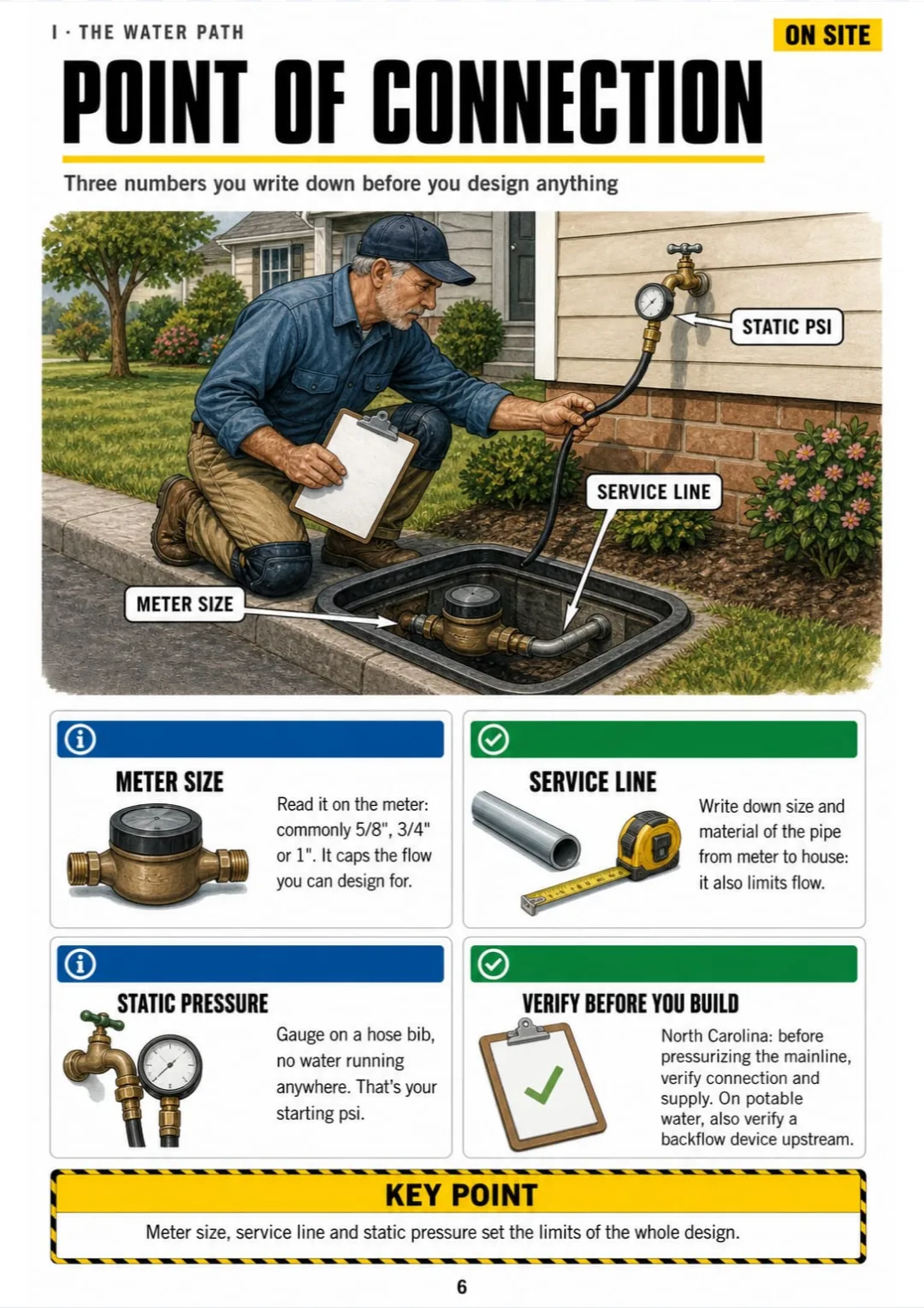
Meter size, service line, static psi: the three numbers that limit every design.
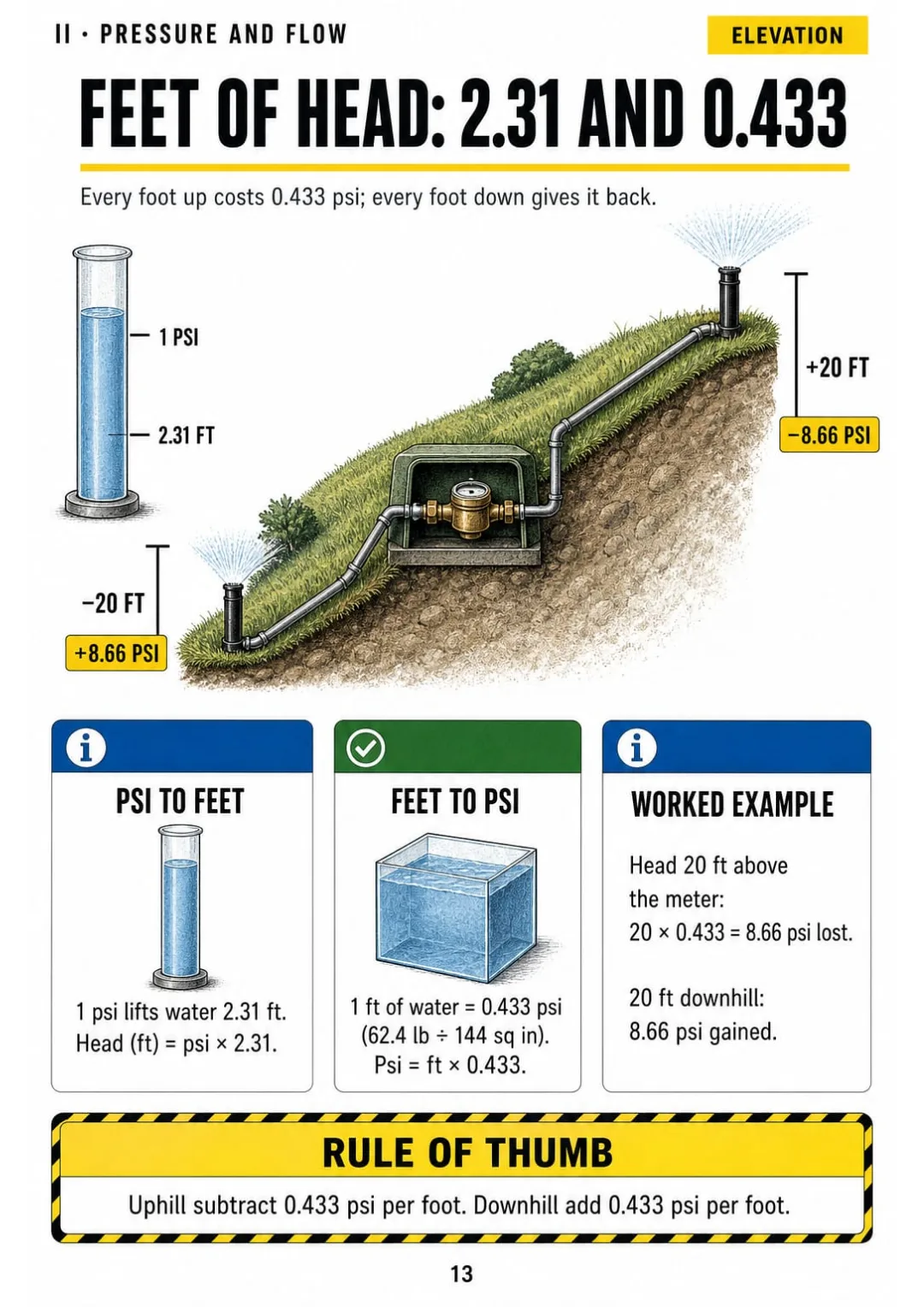
1 psi = 2.31 ft · 1 ft = 0.433 psi · 20 ft uphill = 8.66 psi lost.
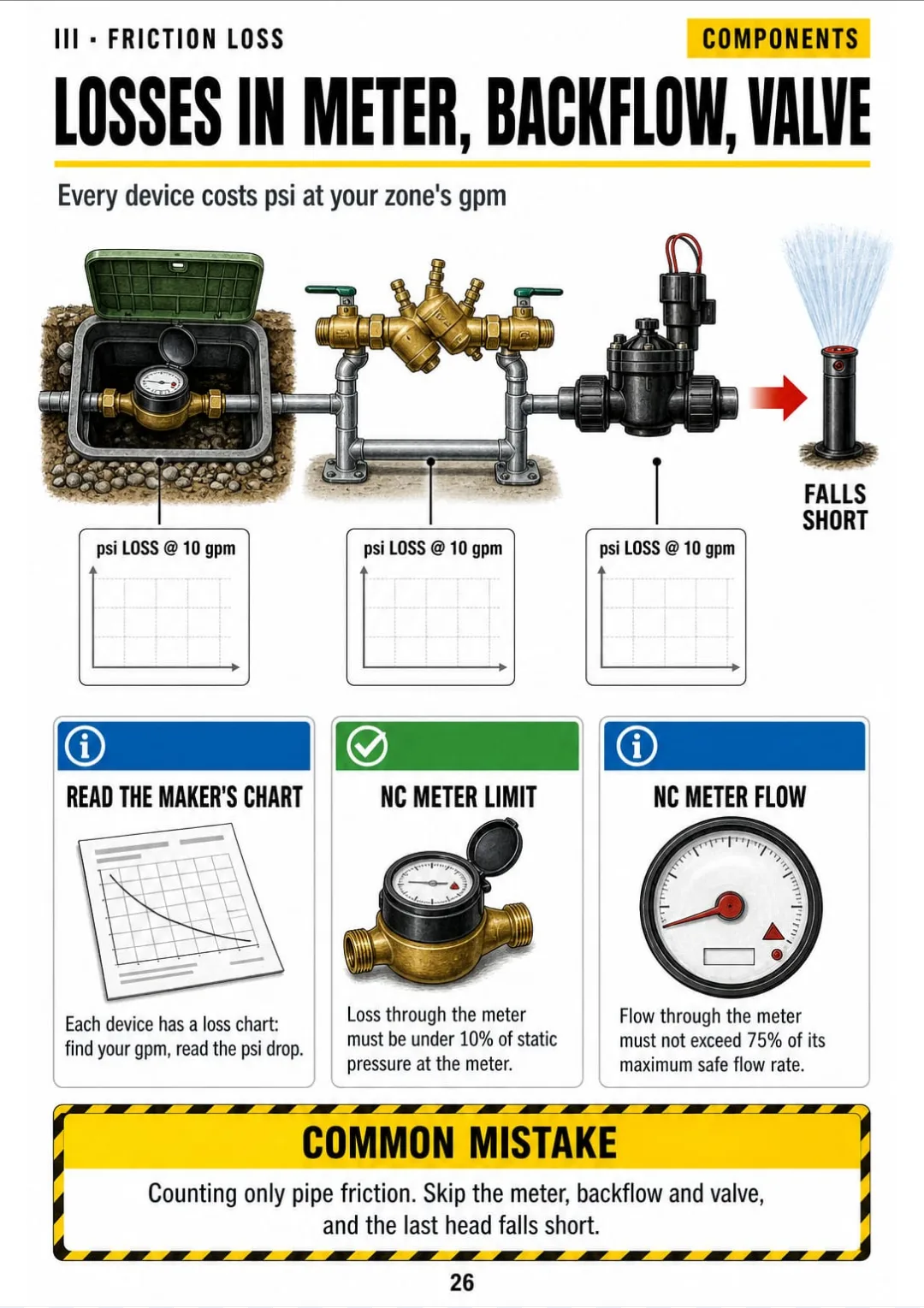
Each device's psi drop comes from the manufacturer's chart at your zone gpm.
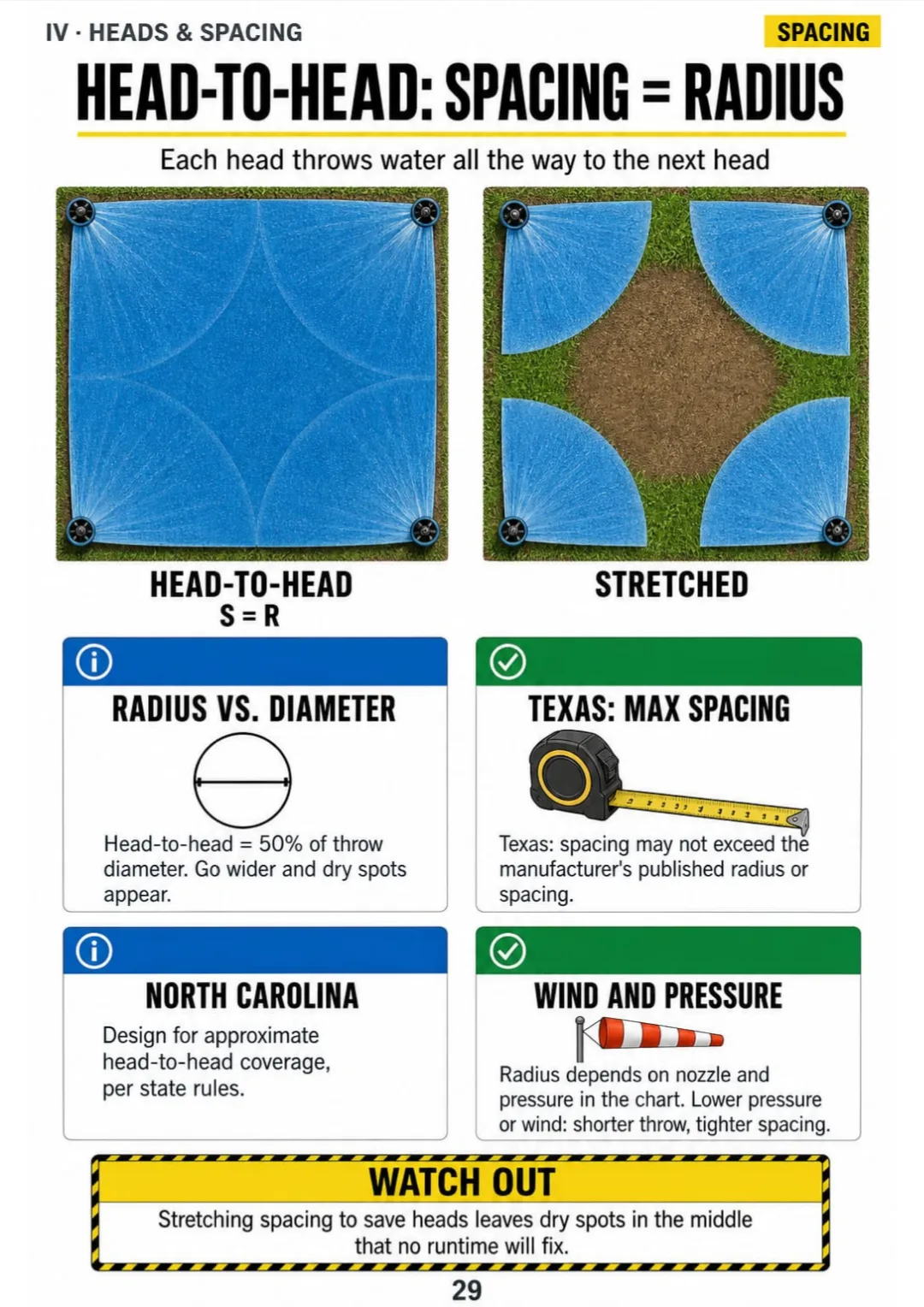
Head-to-head: spacing equals radius; Texas: never beyond the manufacturer's published radius.
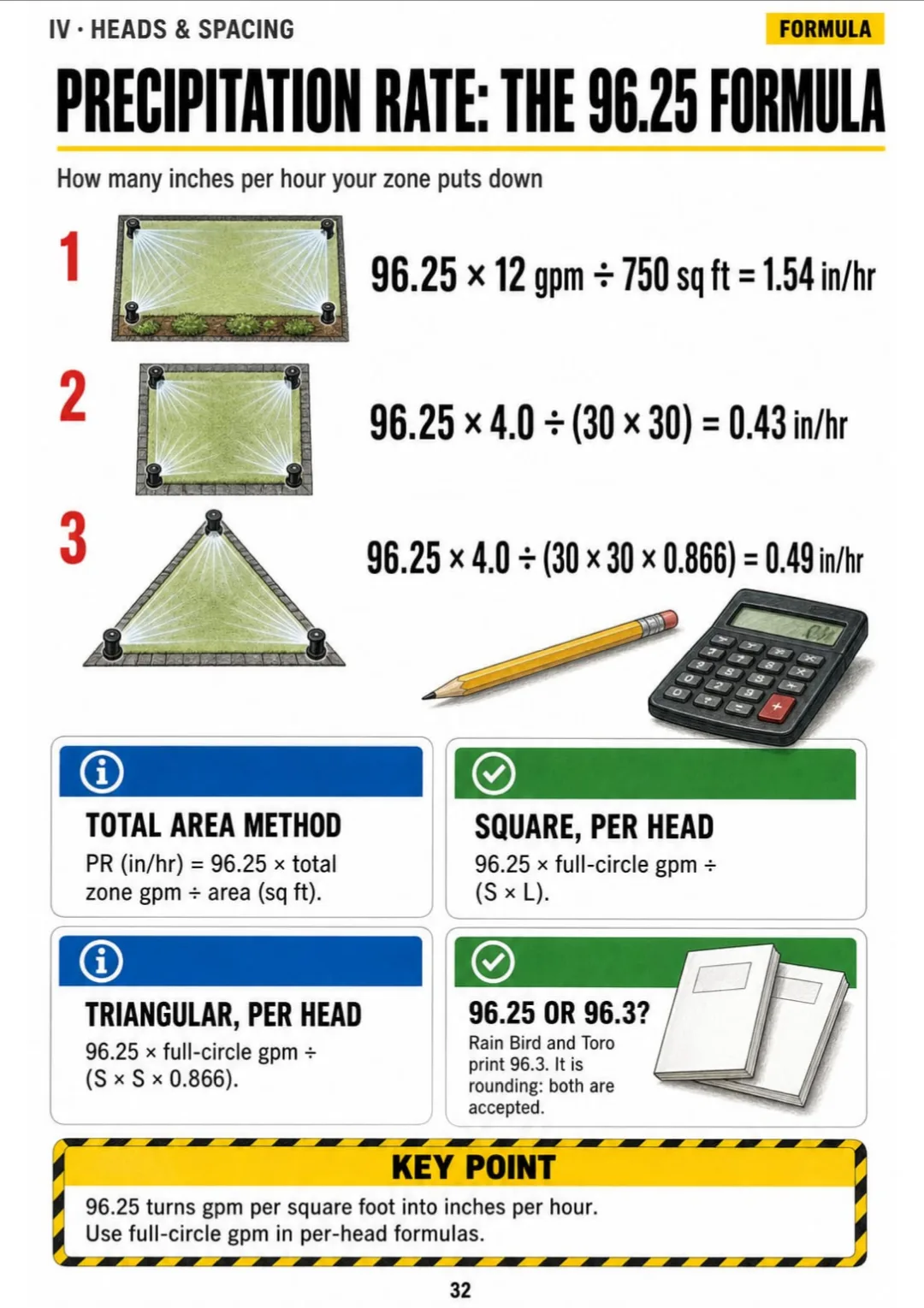
PR = 96.25 × gpm ÷ sq ft; worked: 1.54, 0.43 and 0.49 in/hr.
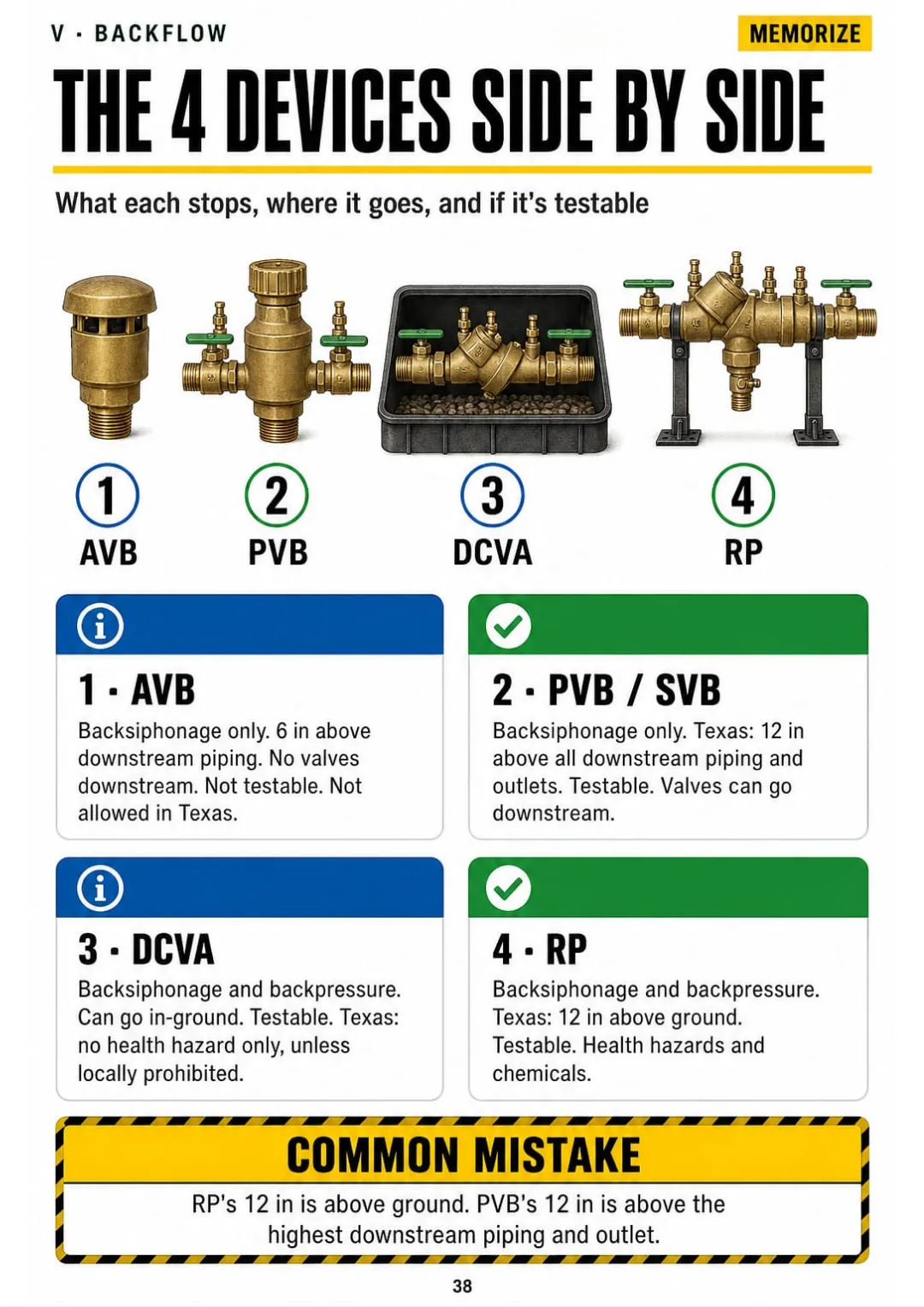
AVB 6 in · PVB/SVB 12 in above downstream · DCVA in-ground · RP 12 in above ground (TX §344.50).
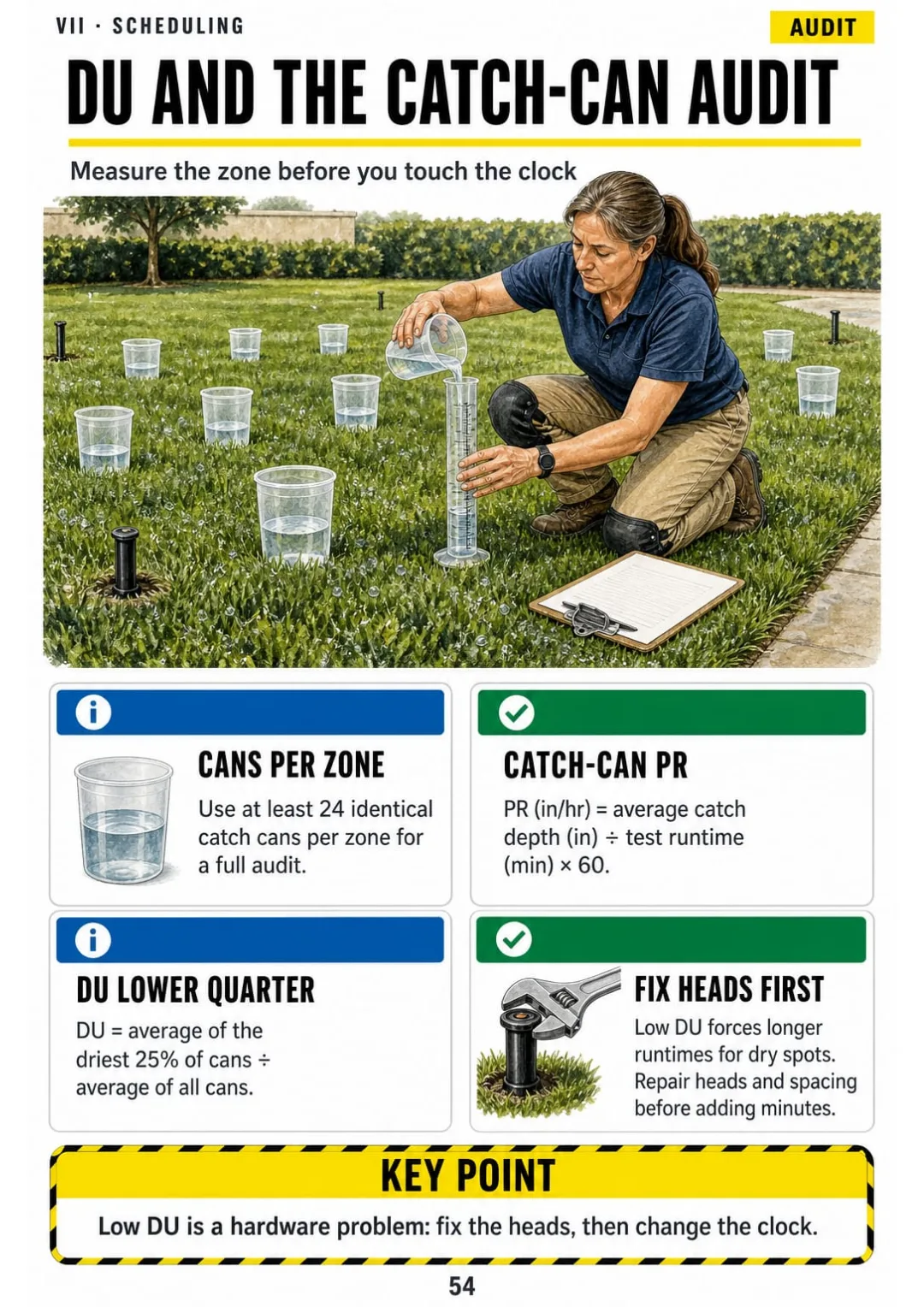
DU = driest 25% average ÷ overall average, with 24+ cans per zone
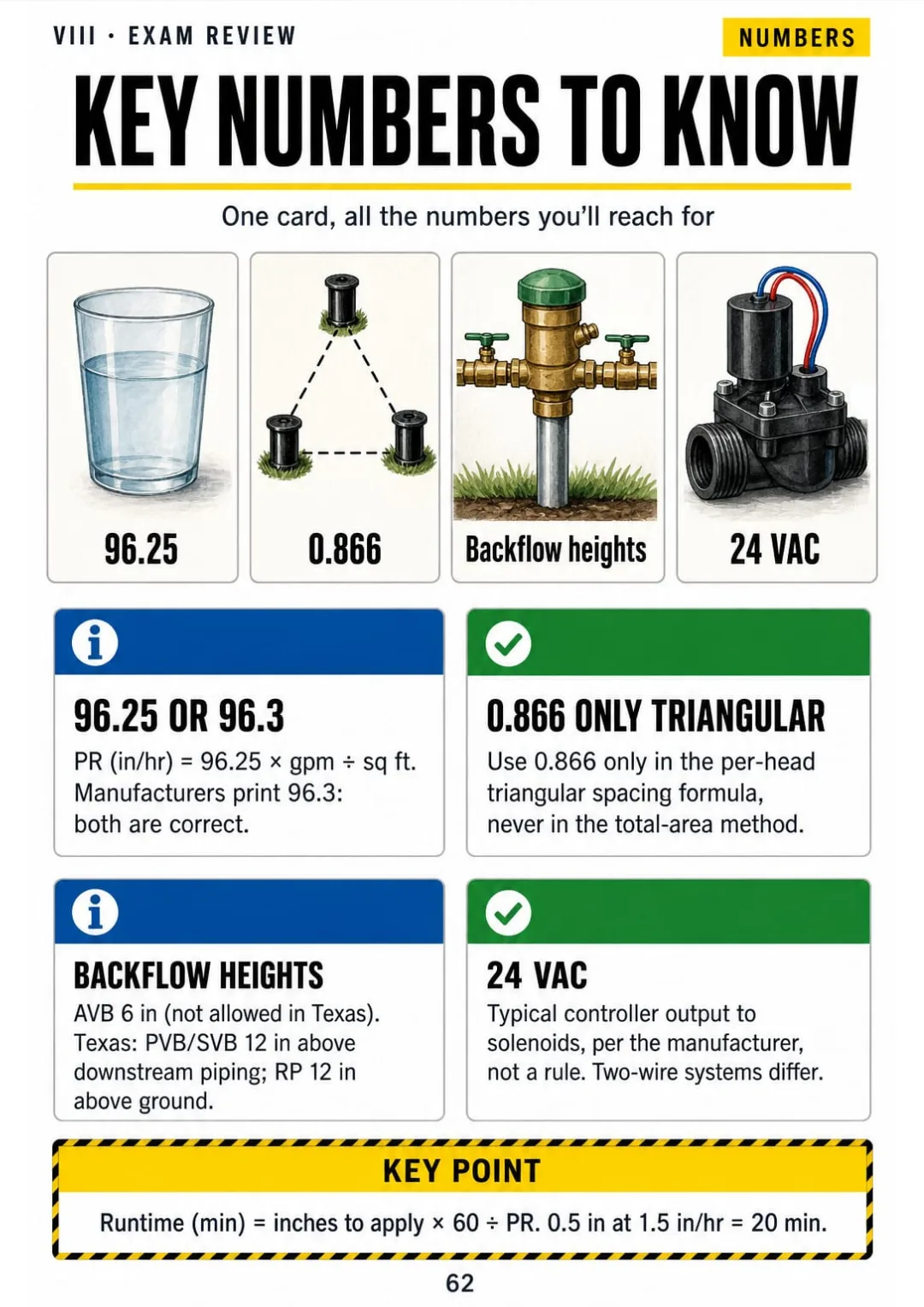
2.31 · 0.433 · 5 ft/s · 96.25 · 0.866 · AVB 6 in · PVB 12 in · 24 VAC

Swipe to see more →

These are real pages from the book. The table of contents is the full one: 8 parts and 60 topics.

The Problem Isn't You. It's How It Was Explained to You.

You're looking at a friction loss chart for Class 200 PVC, with a 3/4-inch lateral carrying 8 gpm, and you need the psi lost per 100 feet before you can size anything.

The manual gives you three paragraphs on Hazen-Williams and a grid of tiny numbers. Nobody shows you which column to start in or where to stop. By the next morning it's just numbers again.

Each device's psi drop comes from the manufacturer's chart at your zone gpm.

In the book, that same chart is one page: pipe column first, then the gpm row, then the psi loss per 100 feet, with the shaded high-velocity zone marked so you never land in it.

Feet of head, the bucket test, head-to-head spacing, the 96.25 formula and the 4 backflow devices each get their own page, drawn the same way.

You read the chart in the same order every time, and you size the lateral without going back to the manual.

COMPARE FOR YOURSELF

The Same Topic, Two Ways to Study It

THIS
  • The manual: line after line of text
  • Pressure conversions explained only in words
  • You walk into the exam still unsure
Pressure in an irrigation system may be expressed in pounds per square inch (psi) or in feet of head, the latter representing the height of a column of water that would produce an equivalent pressure at its base. Since one cubic foot of water weighs approximately 62.4 pounds, a column one foot high exerts a pressure of 0.433 psi, and conversely one psi corresponds to 2.31 feet of head. Any change in elevation between the point of connection and the emission devices must be converted and added or subtracted when determining available operating pressure.
FOR THIS
  • Feet of head in one drawing
  • 2.31 and 0.433 in a box
  • 20 ft uphill = 8.66 psi, drawn on the slope
1 psi = 2.31 ft · 1 ft = 0.433 psi · 20 ft uphill = 8.66 psi lost.
CONTENTS

Take a Look at the 8 Parts and 60 Topics

The water path, pressure and flow, friction loss, heads and spacing, backflow prevention, valves and controllers, scheduling, and rules and exam review: 64 pages, all illustrated.

IThe Water Path · pp. 5-10
  1. One System, One Path: Source to Head
  2. Point of Connection: Where Your System Begins
  3. Mainline vs. Lateral
  4. Pipe You'll Meet: PVC, Poly and Ratings
  5. Fittings, Swing Joints and Isolation Valves
  6. Trench, Depth and Sleeves
IIPressure and Flow · pp. 11-18
  1. Pressure and Flow Are Not the Same Thing
  2. Static vs. Dynamic Pressure
  3. Feet of Head: 2.31 and 0.433
  4. Measuring Static Pressure on Site
  5. Measuring Available Flow: the Bucket Test
  6. Meter Limits: Safe Flow from the Meter
  7. Velocity: the 5 ft/s Rule
  8. Water Hammer and Pressure Surges
IIIFriction Loss: the 5-Step Method · pp. 19-27
  1. Why Pressure Disappears in the Pipe
  2. Reading a Friction Loss Chart
  3. Step 1: Zone Flow
  4. Step 2: Pipe Size
  5. Step 3: Friction Loss in the Run
  6. Step 4: Elevation Change
  7. Step 5: Pressure at the Last Head
  8. Losses in Components: Meter, Backflow, Valve
  9. Too Much Pressure: Regulating and Misting
IVHeads, Spacing and Precipitation · pp. 28-35
  1. Sprays, Rotors, Rotary Nozzles and Drip
  2. Head-to-Head Coverage
  3. Square vs. Triangular Spacing
  4. Matched Precipitation
  5. Precipitation Rate: the 96.25 Formula
  6. Never Mix Sprays and Rotors on One Zone
  7. Drip Basics: gph, Filter, Regulator
  8. Narrow Strips, Slopes and Hardscape
VBackflow Prevention · pp. 36-43
  1. Backflow: Backsiphonage vs. Backpressure
  2. Hazard Level: Why Irrigation Needs Protection
  3. The 4 Devices Side by Side
  4. Atmospheric Vacuum Breaker (AVB)
  5. Pressure Vacuum Breaker (PVB) and SVB
  6. Double Check Valve Assembly (DCVA)
  7. Reduced Pressure Zone Assembly (RP)
  8. Testing, Freeze Protection and Local Rules
VIValves, Wiring and Controllers · pp. 44-50
  1. How a Zone Valve Opens and Closes
  2. Valve Manifolds and Valve Boxes
  3. Low-Voltage Wiring: 24 VAC, Common and Hot
  4. Wire Size and Distance
  5. Multimeter Readings on a Solenoid
  6. Controllers: Stations, Programs, Start Times
  7. Rain, Freeze and Smart Sensors
VIIScheduling and Water Management · pp. 51-57
  1. Evapotranspiration (ET): the Water Plants Use
  2. Crop Coefficient and Plant Water Need
  3. Runtime: Inches Needed ÷ Precipitation Rate
  4. Distribution Uniformity and the Catch-Can Audit
  5. Soil, Infiltration and Cycle-and-Soak
  6. Seasonal Adjustment and Watering Restrictions
  7. Winterization and Spring Start-Up
VIIIRules, License and Exam Review · pp. 58-64
  1. Licenses and Certifications at a Glance
  2. What State Rules Usually Cover
  3. Design Plan and As-Built
  4. The 5-Step Hydraulic Method on One Page
  5. Key Numbers to Know
  6. Most Frequent Mistakes in Hydraulics Problems
  7. Most Frequent Backflow and Scheduling Mix-Ups

One Page, One Topic, All Clear

Think of it this way:

You're on a new install with a 3/4-inch meter and 60 psi static, and you need to know if the last rotor on the zone will still get enough pressure.

You open the 5-step method page and follow the whole run as drawn: zone flow, pipe size, friction loss, elevation, then the pressure left at the last head, with real numbers in psi and gpm.

PR = 96.25 × gpm ÷ sq ft; worked: 1.54, 0.43 and 0.49 in/hr.

Same with the bucket test, head-to-head spacing, the 96.25 formula, PVB height and cycle-and-soak: each one on its own page.

Irrigation Contractor Illustrated is 8 parts and 60 topics, all drawn, ending with the 5-step method on one page, the key numbers and the most frequent mistakes.

What you see drawn, you don't have to memorize.

What's Inside Irrigation Contractor Illustrated:

Ipp. 5-10

The Water Path

The whole system as one path from source to head: point of connection, mainline vs. lateral, PVC and poly ratings, fittings, swing joints, trench depth and sleeves.

IIpp. 11-18

Pressure and Flow

Pressure vs. flow, static vs. dynamic, feet of head with 2.31 and 0.433, the gauge and bucket tests on site, meter limits, the 5 ft/s rule and water hammer.

IIIpp. 19-27

Friction Loss: the 5-Step Method

Why pressure drops in the pipe, how to read a friction loss chart and the 5 steps from zone flow to pressure at the last head, plus component losses and regulating high pressure.

IVpp. 28-35

Heads, Spacing and Precipitation

Sprays, rotors, rotary nozzles and drip, head-to-head coverage, square vs. triangular spacing, matched precipitation, the 96.25 formula and tricky strips and slopes.

Vpp. 36-43

Backflow Prevention

Backsiphonage vs. backpressure, hazard level, the 4 devices side by side, AVB, PVB and SVB, double check, RP, testing and freeze protection.

VIpp. 44-50

Valves, Wiring and Controllers

How a zone valve opens and closes, manifolds and boxes, 24 VAC wiring, wire size by distance, multimeter readings on a solenoid, controller programs and sensors.

VIIpp. 51-57

Scheduling and Water Management

ET and crop coefficient, runtime from inches needed and precipitation rate, DU and the catch-can audit, cycle-and-soak, seasonal adjustment, winterization and spring start-up.

VIIIpp. 58-64

Rules, License and Exam Review

Licenses at a glance (TCEQ Landscape Irrigator, NC Irrigation Contractor and CIC), the rule topics that come up most, design plan and as-built, the 5-step method on one page, key numbers and the most frequent mistakes.

At the end of the book: The 5-step hydraulic method on one page, key numbers to know and the most frequent mistakes in hydraulics, backflow and scheduling.

Plus: 2 Free Books

Irrigation Exam Practice: Questions with Worked Answers

BONUS 1: «Irrigation Exam Practice: Questions with Worked Answers»

Value on its own: US$ 17.90

Test yourself on hydraulics, backflow, scheduling and rules, and see every answer worked out step by step so you know exactly where you went wrong.

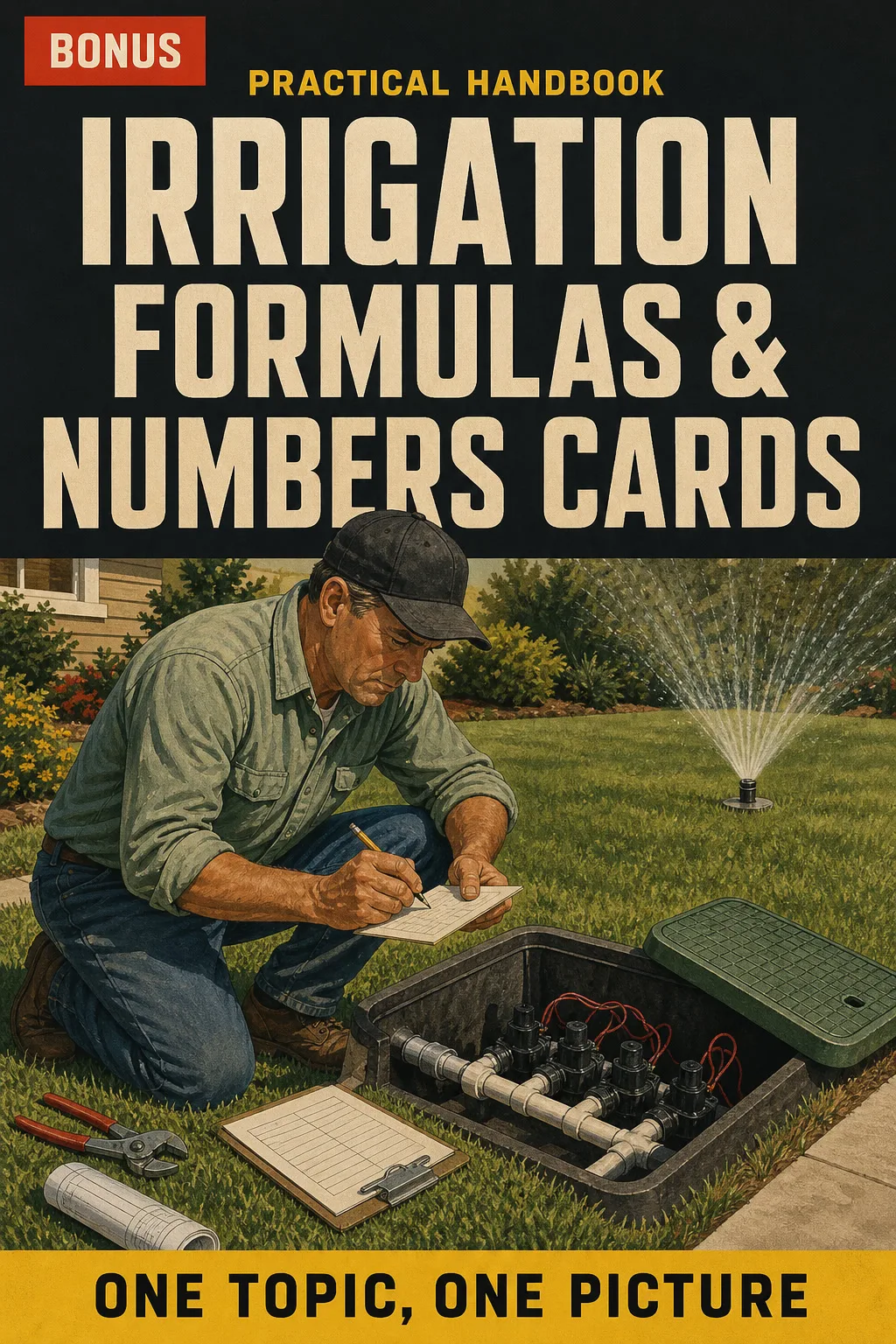
Irrigation Formulas & Numbers Cards

BONUS 2: «Irrigation Formulas & Numbers Cards»

Value on its own: US$ 14.90

Every formula, conversion and key number on printable one-page cards, so you can review in the truck between jobs.

Irrigation Contractor Illustrated with 2 Free Books

  • Irrigation Contractor Illustrated: 64 illustrated pagesUS$ 63
  • BONUS 1: Irrigation Exam Practice: Questions with Worked AnswersUS$ 17.90
  • BONUS 2: Irrigation Formulas & Numbers CardsUS$ 14.90
  • High-resolution PDF to printIncluded
Total value US$ 95.80
YOUR PRICE:
US$ 27
You save US$ 68.80
YES, I WANT IRRIGATION CONTRACTOR ILLUSTRATED FOR US$ 27

📄 This is a digital PDF book sent to your email: nothing is printed or shipped.

Secure purchaseEncrypted payment30-day guarantee

PDF by email: We email you Irrigation Contractor Illustrated as a PDF, together with the two free books. It's a single payment: no installments, no extra charges.

Who This Book Is For

You're learning the hydraulics

You're learning the hydraulics

Every formula comes with a drawing of the pipe it happens in, so friction loss and feet of head finally connect to what you already do on site.

Your license exam is coming up

Your license exam is coming up

The 5-step method, the backflow heights and the key numbers are each on one page, ready to review in the same order every night.

You already run irrigation jobs

You already run irrigation jobs

Print it and keep it in the truck: spacing, precipitation rate, wire size and solenoid readings, there when a zone doesn't behave.

Everything You Get Today

US$ 95.80US$ 27
YES, I WANT IRRIGATION CONTRACTOR ILLUSTRATED FOR US$ 27

📄 This is a digital PDF book sent to your email: nothing is printed or shipped.

30DAYS
GUARANTEE

30-Day Guarantee

Try Irrigation Contractor Illustrated for 30 days, bonus books included.

We refund everything if the file won't open, if the book isn't what you see here, if you were charged twice or if the email doesn't arrive. Just email us.

You pay once. No subscriptions.

Frequently Asked Questions

Is this for me if I've installed systems for years but haven't studied in decades?

Yes. It starts from what you already do in the field and draws the why behind it. Every calculation follows the same 5 steps, with real numbers in psi, gpm and feet.

Does it work for my state's exam?

Hydraulics, spacing, precipitation rate, valves and scheduling work the same in every state. The state rules are checked against Texas (TCEQ, 30 TAC Chapter 344), North Carolina (G.S. 89G) and the Irrigation Association's CIC exam outline. If you test in another state, confirm its current rules and backflow heights with your licensing board.

Is this official material?

No. It's an independent illustrated study book, not issued or endorsed by any state agency, licensing board or the Irrigation Association. Use it next to your course manual: the manual has the full text, the book draws each topic on one page so you review it in the same order every time.

Does it replace the required course or training?

No. It's a study companion: it doesn't give you a certificate, a license or continuing education hours. If your state requires a course, training hours or field experience, you still need to complete them.

Are the practice questions the ones on the exam?

No. They're written for this book to help you practice the topics, with every answer worked out step by step. They aren't official exam questions.

When and how do I get it?

You get the book and the 2 bonus books as PDFs by email, sent to the address you enter at checkout.

Do I have to pay every month?

No. It's a one-time payment. There's no subscription.

Can I have it on paper?

We don't ship a printed book: you get a PDF by email that's made to print. Print the whole book or just the pages you want to keep in the truck.

How does the refund work?

You have 30 days. We refund everything if the file won't open, if the book isn't what you see on this page, if you were charged twice or if the email doesn't arrive: just email us.

Before You Close This Page

No more rereading charts that never stick.

No more guessing at friction loss: you see it drawn.

You walk into the exam knowing where everything is.

Drawings make studying faster.

The book is right below.

One-time payment: US$ 27 · Guarantee: 30 days · PDF by email

YES, I WANT IRRIGATION CONTRACTOR ILLUSTRATED FOR US$ 27

📄 This is a digital PDF book sent to your email: nothing is printed or shipped.